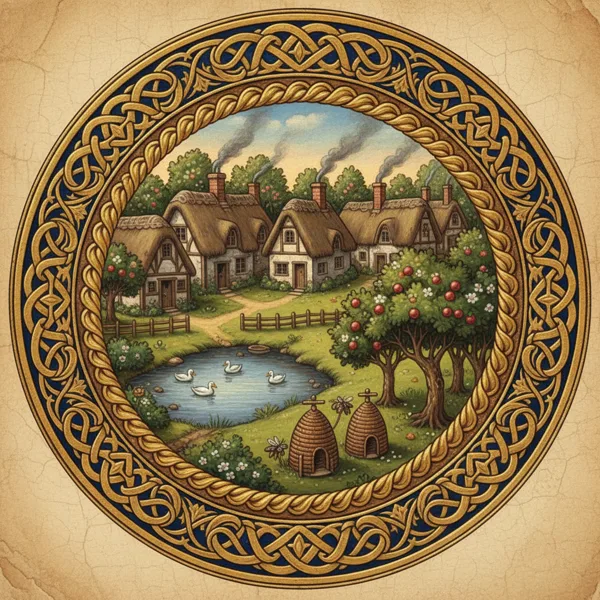
A village name is written by whatever the founders saw first and liked, and what founders like, overwhelmingly, is food. Applewick had the orchards. Barleybrook had the water for brewing. Honeycombe had the hives, and still does, and will sell you a jar with a warning about the bees' temperament that you should take seriously.
The pattern is smaller and warmer than a town's: an orchard, an animal, or a stream, joined to a word that means a fold in the land where people fit. Combe and dell and hollow for shelter, thorpe and wick and worth for the farms, green and pond for the shared middle where everything actually happens.
The smallest places skip the pattern and keep a definite article, the way a family keeps a nickname: the Skeps, the Churns, the Lanes. Ask how the Lanes got its name and you will get four answers and a walking tour, and the tour is the real answer. Villages are the only places on the map that are named entirely from the inside.
The difference between a village name and a town name is ambition. Towns are named by charters; villages are named by shepherds, and the shepherds were not performing for posterity. The names run smaller and more honest: a well, a hedge, a muddy lane that was memorable chiefly for the mud. When the grimoire deals a village name that sounds slightly apologetic, that is the register working as intended.
Villages carry adventure weight precisely because nothing is supposed to happen in them. The records the archivist keeps suggest a reliable ratio: for every village the party is meant to save, name two they merely pass through, and make all three sound equally sleepy. Horror writers have known the trick for a century. The village called Nettlebrook earns its dread only if Cresswell and Thornden, two hills over, stayed boring.
The elements of the old tongue
Apple- old orchards
Badger- badger setts in the hill
Barley- beer country
Bramble- hedged lanes
Clover- sweet grazing
Dew- morning mists
Fern- shaded hollows
Goose- the geese police it
Hazel- nut groves
Honey- famous hives
Lark- dawn birdsong
Mole- turned earth
Village Names From the Grimoire
- Hazelcombe nut groves + folded hills
- The Tithes the abbey remembers why
- Sorrelenbrook wild herbs + on the stream
- Fernpatch shaded hollows + smallholdings
- Applegreen old orchards + common green
- Brambledown hedged lanes + open chalk hill
- Thistlend stubborn soil + the lane stops here
- Molecot turned earth + a few cottages
- Honeyfield famous hives + cleared farmland
- Badgermead badger setts in the hill + hay meadows
- The Steading one farm that grew
- Larkworth dawn birdsong + fenced homestead
- Thistlebrook stubborn soil + on the stream
- The Lanes no two meet at right angles
- The Churns butter for three counties
- Thistlemead stubborn soil + hay meadows
- The Skeps everyone keeps bees
- Goosedown the geese police it + open chalk hill
- The Wickets gates in every hedge
- Plumworth plum harvests + fenced homestead
Margin notes
What makes a village name different from a town name?
Scale of anxiety. Towns are named for defenses and trade: fords, holds, markets. Villages are named for comforts: orchards, meadows, the pond. If the name would fit on a jam label, it is a village.
How do I name villages around a larger town?
Reuse the region's stream and hill words and let the first element go local: if the town is Eastmere, the villages are Ferndell, Willowmere, and Goosegreen. Shared suffixes make a hinterland read as one parish.
Should village names foreshadow anything sinister?
The contrast is the trick. A cellar under Honeylea is worth three under Gloomhollow. Name the place for its comforts and let the players learn what the comforts are paid for.
What makes a village name different from a town name?
Scale and author. Villages are named by the people who lived there, after wells, hedges, fords, and mud, with no charter and no audience. Keep them small and slightly humble, and save the grand constructions for cities that hired heralds.
Last inscribed 2026-10-01